Aug 21, 2012

"Society" (1989)


  • Directed by: Brian Yuzna
  • Written by: Woody Keith & Rick Fry
  • Starring: Billy Warlock, Devin DeVasquez, Evan Richards
(Note: This review contains spoilers. I don't usually like putting spoilers in my reviews, but in this case, I need to in order to properly articulate my thoughts on the film. If you're not interested in having this movie spoiled, stay away.)     

     Criticizing films can be an arduous process. If a film has beautiful visuals but an incompetent story, does that make it bad? If a film has an amazing plot but looks like it was filmed in someone's backyard, does that make it good? Similarly, should a film be judged by the strength of its individual scenes or by the sum of its parts? "Good" and "bad" are very rarely clear cut, and making a decision to recommend something can be hard to do. It's with this thought in mind that I recommend Brian Yuzna's 1989 horror effort, "Society," but with some very important caveats.
     Bill Whitney (Billy Warlock) is an outcast. He lives with affluent family up in Beverly Hills, and he is all set to become the next student body president, yet he feels as if he doesn't belong. His family and friends are distant, he's filled with paranoia for something that he can't explain, and he is constantly plagued by nightmares. One day, his sister's ex-boyfriend, Blanchard (Tim Bartell), shows him a tape that he recorded of his family participating in what appears to be a strange, incestuous orgy. With the help of his friend Milo (Evan Richards) and a weird girl named Clarissa (Devin DeVasquez), Bill decides to investigate, and discovers that his "family" are actually strange creatures that literally feed off of the poor for energy.
     Objectively, "Society" is not a great movie. Brian Yuzna's direction is without much style or suspense, the score is full of cheesy, buzzing synths, the characters are cardboard cutouts, and it's all wrapped up in a ham-fisted metaphor about high society. What is possibly the worst aspect of the film, however, is the plot. It's riddled with holes. Why would Bill's sister leave her (bugged) earrings on during an orgy? Why was Bill taken into this society and groomed for 18 years just to be fed upon? Why does Clarissa's mother seem brain damaged, and why is she obsessed with eating hair? If this incredibly suspicious society of ancient creatures live in public, how have they not been caught? Were Milo and Blanchard meant to be groomed as well?
     The film doesn't answer any of these questions, and offers absolutely no explanation or reasoning behind the film's events or the character's actions. I suspect that the filmmakers thought they would be vague and leave the audience to decide for themselves, which is fine, but not when the mystery doesn't make any logical sense.
     With all that said, why in the hell am I recommending this film? Let me set the scene for you: We've spent almost the entirety of the movie being built up to what this society might be, only glimpsing strange behavior and hearing some whispered notion about "society". Finally, Billy bursts into his house, where his family reveals their dark secret, and in order to demonstrate what they are they bring in Blanchard, who was previously thought to be dead. What follows is one of the most shocking and imaginatively disgusting scenes I've ever seen in a film, in which all of the members of this twisted society participate in a sickening orgy of flesh.
     Every single person is formed together in an orgiastic, slimy ball of squirming meat, sucking the life out of Blanchard's body. Hands erupt from mouths and latch onto eye sockets. Limbs bend and contort around each other. A man's head transforms into a gigantic, grasping hand. It all culminates in a scene where Billy witnesses his own family formed together into one hellish being. Arms are where legs should be, his sister's head hangs from his mother's groin, and his father's face emerges from his mother's detached anus. It's horrid, sickening, and utterly unlike anything I've seen in a horror film.
     Screaming Mad George is the special effects artist who's demented imagination supplied the concept for the scene, as well as the effects for the film. His work is the real star of the movie, and this scene is the reason that I recommend "Society". It's an incredible finale, but the problem with it is that it's buried underneath 70 minutes of a mystery that's badly written and uninteresting. But, if you're a horror or special effects fan that's willing to put up with that, I doubt that you'll be disappointed.

Aug 13, 2012

"Nightbreed" (1990)


  • Written & Directed by: Clive Barker
  • Starring: Craig Sheffer, Anne Bobby, David Cronenberg

     A common stereotype in Hollywood is that the higher-ups working in the Land of Dreams frequently miss the big picture. The idea is that an executive's brain has been so completely fried from years of looking at box-office receipts that the only thing they understand is money. Unfortunately, there's been little to disprove that stereotype, and no where is that more apparent than in the handling of Clive Barker's underrated horror opus, "Nightbreed".
     "Nightbreed" tells the story of a tortured young man named Aaron Boone (Craig Sheffer) who constantly dreams of a mystical city called Midian, which is populated solely by monsters. He is convinced that this dream city is real, while his cold, calculating psychiatrist, Philip Decker (David Cronenberg), believes that it is merely a fiction developed by his "sick" mind. Little does Boone know that Decker is also a murderous madman, hellbent on cleansing the world of "filth," who subsequently frames Boone for murders that he himself committed.
     Delirious with guilt, Boone ventures to a graveyard on the outskirts of town, where he discovers that Midian is indeed real, but the creatures who live there, convinced that Boone is an "innocent," do not want him. But, after Decker tricks the local police force into killing him, he is resurrected by the monsters of Midian and transformed into one of them, a Nightbreed. Meanwhile, his faithful girlfriend Lori (Anne Bobby), convinced that he is not really dead, sets out to Midian to find him. Unfortunately, Decker is close behind, and what ensues will decide the fate of Midian itself.
     "Nightbreed" is one of those rare films that gradually grew much better the more that I watched it. The first time I saw it, I dismissed it as a film full of wasted potential, with visuals that didn't live up to Barker's previous directorial effort, "Hellraiser". Nothing could be further from the truth. "Nightbreed" is a unique, gory, and utterly imaginative fantasy film that was unfairly maligned by its studio and snobby film geeks like me.
     Unfortunately, Barker's vision of "Nightbreed" far surpassed what anyone at its studio, Morgan Creek, wanted. The original cut of the film was over 2 and a half hours long, with plans for a trilogy of films. The studio made Barker cut over an hour of footage, spent little money on marketing, released soporific trailers that didn't properly represent it, refused to hold screenings for critics, and completely misunderstood what the picture was about. Consequently, "Nightbreed" made very little money at the box office and all but destroyed Clive Barker's film career.
     This unfortunate meddling is what leads to most of "Nightbreed's" flaws. With more than an hour missing from a 160 minute film, events shoot by at a lightning pace, giving the film absolutely no time to set up its world or characters properly. People are killed just as quickly as they show up, seemingly important plot points have almost no screen time while other, seemingly unimportant plot points spring out of nowhere, and nearly everybody is reduced to paper-thin characterizations.
     Yet, despite all this, the picture still rises above its shortcomings, and while "Nightbreed" is not a great film, it is a good one. One of the reasons for that is the incredible concept. By casting the monsters as the good guys and the humans as the villains who destroy what they don't understand, the film weaves a gripping story that will speak to anyone who has felt like an outcast or a loner. I think that, perhaps, as a gay man, Barker felt very close to this story, and his love for it shows through every frame. After all, who among us wouldn't wish to be a powerful creature of the night?
     The film also represents tremendous growth for Barker as a director. In "Nightbreed," his budget has graduated from a meager 1 million dollars (on "Hellraiser") to a substantially more workable 11 million, and he's eager to prove himself. Make no mistake, if you love monsters, if you love special effects, you will love this picture. Barker pulls out all the stops, and in Midian he conjures up a dark, majestic city, packed with strange creatures of all shapes and sizes. Within lives a man with purple skin, head tentacles, and fangs. A strange, birdlike woman who shoots quills out of her back. A dark-skinned, curly-horned devil. Oh, and the Berserkers. Just wait until you see them.
     It's spurred along by a fantastic Danny Elfman score, and the cast is uniformly solid, David Cronenberg being the biggest surprise. While he's known more for his fantastic films, he turns in the movie's strongest performance as the detached and icy Decker. While there are a few things about the movie that don't gel (monsters cursing, weird comedic moments), and its final cut is a complete mess, Barker's visual richness and abundance of ideas work together to pull it out of the mud, and what emerges is a deeply flawed, but wholly fascinating love letter to monsters. If you love monsters, you owe it to yourself to see this underrated gem.

Oct 30, 2011

"The Three Musketeers" (2011)

   
     (Hey, guys! I'm back after experiencing a long dry spell, the reasons of which are too complicated and boring to mention, so I'll get right into it with my newest review. I hope you enjoy!)

  • Directed by: Paul W.S. Anderson
  • Written by: Alex Litvak & Andrew Davies
  • Starring: Ray Stevenson, Matthew MacFayden, Logan Lerman, Luke Evans, Milla Jovovich

     Paul W.S. Anderson, despite directing many stinkers, has proven himself to be a competent visual stylist. In films like “Event Horizon,” the plot and characters didn’t have to make sense when the awe-inspiring production design did the atmospheric work (the “heart” of the ship still gives me shivers). Now, Anderson’s newest film, a re-imagining of Alexandre Dumas’ “The Three Musketeers,” proves that, while good visuals and an excellent production design can keep a movie from being a stinker, it can’t completely hide a movie that utterly fails at the script level.
     The Three Musketeers are Athos (Matthew MacFayden), Porthos (Ray Stevenson), and Aramis (Luke Evans), a group of 17th century spies who work to protect France and it’s ruler, the fey, teenaged King Louis XIII (Freddie Fox) from disruption. However, they are outsmarted by the double-crossing female spy, Milady de Winter (Milla Jovovich), who is in league with the Duke of Buckingham (Orlando Bloom), after which they are disbanded by the manipulative Cardinal Richelieu (Christoph Waltz). One year later, a fresh-faced descendant of a Musketeer, D’Artagan (Logan Lerman), descends upon the former glorious trio in order to become one of them. The adventure that ensues involves double crossing, betrayal, romance, and a diamond necklace.
     It’s all quite a very fun plot to mount a cheeky adventure movie on top of, which isn’t surprising, considering that, for the most part, it’s taken directly from Dumas’ classic novel. What the movie does differently is inject the basic plot of the novel with a steampunk sensibility and a slick sense of style. Usually, “updating” a classic in such a way would be suicide, but the movie doesn’t pretend to play anything straight, it’s meant to be a comedic action-adventure in the vein of “Indiana Jones,” and nowhere is this reflected better than in the look and feel of the film.
     The world that the Musketeers inhabit is a surreal exaggeration of the 17th century, like a full-color illustration in an adventure novel. Characters wear flamboyant costumes that positively pop with color, the sets are gigantic and ornate, and the ships are lousy with elaborate, over-the-top weaponry. In particular, the Cardinal’s airship is a triumph of the film’s comic-book production design, with a large red sail and a maidenhead depicting a glittering golden skeleton leering with malicious delight. It’s like a Josef von Sternberg film by way of Sam Raimi, and that’s every bit as delicious as it sounds.
     The action scenes, too, are filled with a wide-eyed, vigorous sense of fun. Characters swing off of buildings, dodge epic traps, and plot schemes that take down scores of men. There’s even a fair amount of regular old swashbuckling as well. It’s hard not to get giddy, and the film deftly avoids bloating itself with too much noise and chaos because we know that from the very first frame of the movie, there isn’t a serious bone in its body.
     Unfortunately, the film splutters and faults in every other aspect. Whereas the visual feel of the film perfectly communicates a sense of comic-book, pop-art fun, the parts of the script that aren’t used for visual panache or taken from the novel are horrendous. It spends far too long attempting to form some sort of tragic love story between Athos and Milady, during which the film grinds to a halt, and it is also littered with clunky one-liners, boring and unsurprising plot twists, and a few lines of dialogue that sound so modern that they almost completely ruin the movie.
     The actors do a  decent job with what they’re given, but the Three (Plus One) Musketeers aren’t really required to do anything but be smarmy and cool, and in Lerman and Jovovich’s cases, they are utterly painful. Both Lerman and Jovovich speak in aggressively modern American accents, in contrast to absolutely everyone else, who speaks in an English accent. It would be fine if the cast picked a single accent and stuck with it, but the intrusion of several accents at once in a group of characters that are all supposed to be from the same place leads to some surreal moments, such as an awkward and contrived exchange between D’artagnan and Aramis in which the young Musketeer responds to the admonishing Aramis’s verbose exchange with, “In French, please.”
     Where the film really shines in the acting department is in the supporting cast, aside from the fact that the film is full to bursting with many underused character actors, such as Til Schweiger and Mads Mikkelsen. Freddie Fox is a gleeful delight as the red-headed, foppish King, always wearing flamboyant clothing and speaking in an awkward, pubescent lilt. Likewise, Christoph Waltz chews the scenery as Cardinal Richelieu. There’s never a moment when his face isn’t plastered with an absolute shit-eating grin, and he barely hides his contempt for King Louis.
     “The Three Musketeers” is a beauty to behold and it’s a lot of fun, but it’s not slick enough to forgive the movie’s flaws in every other department, and your enjoyment of the picture rests entirely on whether or not you can put up with that. If you don’t want anything more than a solid action-adventurer to distract you for 90 minutes, you’ll probably have a good time.  However, if you’re out for something a little meatier, you’d be better off staying at home and watching “Raiders of the Lost Ark” for the 500th time.

Oct 8, 2010

"The Quatermass Xperiment" (1955)


  • Directed by: Val Guest
  • Written by: Richard Landau & Val Guest
  • Starring: Brian Donlevy, Jack Warner, Richard Wordsworth, Margia Dean

     When it comes to movies and television (but especially television), it seems that the British have always seemed to have had their fingers on the pulse of society a lot more than America, as far as entertainment goes. When our movies were just black and white glimmers of unreality and happiness, full of censorship and infantile storylines (not that Americans haven't made some great films), the British were attacking much more challenging, thought-provoking issues in their films. In fact, the British were the first to make a film that explicitly discussed homosexuality in the 1961 film "Victim", years before Americans would even think about such a subject.
     Even in the realm of science-fiction the Brits were much farther ahead (and some might say they still are). The forefather of modern TV sci-fi is the late Nigel Kneale, a Manx writer who wrote tons of TV shows and teleplays for networks like the BBC and ITV from the 50s to the 70s. His work often mixed pulpy science-fiction storylines with other genres like mystery and even horror. He was also well-known for writing such prescient TV plays as "The Year of the Sex Olympics", about a society that has grown bored due to having no rules and no inhibitions and instead resort to watching a reality type tv show for entertainment. However, his most famous creation is undoubtedly the character of Bernard Quatermass.
     Quatermass was a shrewd but intelligent British scientist that appeared in three serials back in the 1950s: "The Quatermass Experiment", "Quatermass II", and "Quatermass and the Pit". The serials were revered in their day for being some of the first televised science fiction that was written specifically for an adult audience, and featured very emotional, human storylines balanced with grisly sci-fi action. In 1955, the fledgling movie studio known as Hammer Films became interested in making a film version of the first serial, "The Quatermass Experiment", and set out to create an adult, X-rated science fiction film. This fact was actually advertised in the title itself, in which the serial was renamed to "The Quatermass Xperiment", and this leads us to our review.
     Bernard Quatermass (Brian Donlevy) has worked with a team of scientists to design and launch the first manned rocket sent into space. The rocket returns to Earth safely, but two of the three men inside have mysteriously died, with the remaining member, Victor Caroon (Richard Wordsworth), now catatonic. Quatermass sets out to find out what happened on the flight that killed the other two men. Meanwhile, Caroon begins to undergo some strange changes, mutating into a sickening alien creature.
     At first glance you could be forgiven for thinking that this is just another sci-fi B-movie, but upon further inspection it appears to be something more than that. The film is directed in a very gung-ho style, almost like a documentary or a newsreel, with lots of handheld camerawork and long tracking shots. It makes the audience feel that they are right there in the action. This, combined with the dark black and white cinematography, infuses the film with a gritty realism that is rare in science fiction from this era.
    The plot itself is a deft blend of mystery and sci-fi, with about 75% of the film devoted to the investigation of the astronauts. Scenes are intercut with Quatermass and others investigating what happened to the astronauts with constant updates on what is happening to Caroon, and as Caroon mutates further and we find out more about the astronauts themselves, the film becomes very taut and suspenseful, despite it's lack of directorial tricks. We come to worry about what's going to happen organically, rather than relying on the cinematography and the music to guide our feelings.
     It's a very engrossing mystery, and the explanation behind the astronaut's disappearance and Caroon's condition, while not entirely original, is creative and well-presented. This all leads up to a very harrowing and exciting confrontation inside of Westminster Abbey.The film was made for a very miniscule budget (about 66,000 dollars), but it is used very economically, due to the airtight direction and cinematography, and you'd never realize that the film was made for so little. The special effects of course leave something to be desired (especially in the climax) but, considering the low budget, they do their job well, and they're used sparingly, so they don't detract from the film at all.
     I also found myself surprised at how dark and adult the film was for 1955. It makes American films of the period look like a bunch of kittens and rainbows. Of course, to a modern audience the film shows nothing very shocking, but as I mentioned earlier, it did receive an "X" rating originally, and for good reason.
     The alien that Caroon morphs into takes energy and grows by literally sucking out the nutrients of the people and creatures that it touches. Therefore, when Caroon commits his first murder, we get a nice shot of the victim's face with it's flesh missing, bone exposed, and it's body emaciated. Granted, it's only for a moment but it's a surprisingly violent moment for such an old film.
     Later on, while the coroner is examining him, he mentions that "the bone has been reduced to powder". Just the thought makes me sick. There is also a brief mention of child molestation as well. This dark, violent, even slightly angry tone is really surprising for such an old film, but it's also very refreshing after growing up with nothing but the tired old American stuff.
     Unfortunately, it's far from perfect. One of the main things that brings the film down is it's horrid acting from Brian Donlevy as Quatermass. He's American, for one thing, so he really sticks out among all of the Brits in the cast, and he stares at everyone in a fierce way, spitting out all of his lines in a slightly apathetic growl. It gives the impression that Donlevy really didn't care too much about the character, which would make sense because at the time he was a raging alcoholic and probably just wanted to get the thing done. There is also some nearly comatose acting from Margia Dean as Caroon's wife, Judith. What could have been an emotional and heartwrenching role as the wife is forced to watch her husband metamorphose before her eyes is relegated to a blank, unemotional performance from Dean, who seems unsurprised by absolutely everything and uses the absolute minimum of effort with her lines.
     While the lackluster acting really puts a damper on the film, the biggest mistake is the ending itself. I will say that I haven't seen the original serial, but I have to admit that the downplayed, intellectual ending of the serial sounds much more satisfying and thought-provoking then the predictably violent and explosive climax of the film. While the alien creature could have drawn sympathy from the audience, instead our primal thirst for violence is slaked, which is exciting at first but ultimately feels really unsatisfying after previously enjoying the film's dark, subtle atmosphere. The two parts don't connect. Nigel Kneale himself was also upset about this change.
     Luckily, these things do not ruin the film, but merely keep it from becoming the classic that it should have been. However, this is still a very strong, intriguing, and adult science fiction film from an era when movie theaters were inundated with bland, lackuster, cheesy efforts. It's shot and directed beautifully, and the mixing of the science fiction and mystery genres prove to be a huge precedent for future productions, such as "The X-Files". Very good, and very influential, if you like science fiction this is highly recommended.

Oct 4, 2010

"Perfect Blue" (1997)


  • Directed by: Satoshi Kon
  • Written by: Sadayuki Marai & Satoshi Kon
  • Starring: Junko Iwao, Rica Matsumoto, Masaaki Okura

     The news of renowned director Satoshi Kon's passing is a shocking and unexpected piece of news. Kon's death has not only saddened anime fans, but it has saddened film fans as well, myself included. Kon's films had a universal appeal that broke through the usual trappings of their medium, so rather than being appreciated merely as good anime films, they are widely appreciated as great films in their own right.
     My own experiences with Satoshi Kon have been memorable and rewarding. I first became aware of his work in middle school, when his hallucinogenic fever dream, "Paranoia Agent", was running through the airwaves. I found it very surreal and a bit hard to understand, but it was incredibly creative and a visual treat, as well as giving the viewer a lot to think about and offering no easy answers as to who or what "Little Slugger" was.
     The first feature film of his that I saw was "Paprika", during Freshman year. I identified very highly with the surreal story of exploring dreams, and found myself sucked in my it's "whodunit" style storyline and it's colorful images and characters. Once again, Satoshi Kon had floored me.
     However, I haven't seen all of his work, and so, in honor of his passing, I've decided to review his first proper feature film, an 80 minute psychological thriller entitled "Perfect Blue".
     Mima Kirigoe (Junko Iwao), a famous pop-star, decides to abandon her musical duties as part of the girl group named CHAM!, and instead decides to focus on becoming an actress. She has trouble finding a part at first due to her previous fame as a pop star, but soon she lands a role on a very controversial, violent cop show. This sudden change from her clean pop-starlet image causes many of her most ardent fans to react in anger, and soon Mima begins receiving strange letters and faxes from a stalker who refers to himself as "Me-Mania" (Masaaki Okura). However, after performing a scene in the show where she is traumatically raped, Mima begins to slowly lose her grip on reality, and members of the cast and crew begin to be grotesquely murdered, arousing questions as to whether or not the killer is Me-Mania, Mima herself, or someone else entirely.
     The first thing that struck me about the film is how much it strays from the traditional anime narrative. Of course, that's something that I've always liked about Satoshi Kon's works, they don't fall into the traditional trappings of the medium, but this film is surprisingly disjointed and experimental in the way it tells it's story. There are layers of unreality in the film, dreams within dreams that increase in frequency until we're not sure if what we're seeing is a hallucination or if it's actually reality. This style perfectly sets us up for the film's constant red herrings and psychological twists. As the surreal tone of the film increases and becomes more prominent, it feels as if we are seeing these events through Mima's eyes, which greatly helps us feel for her and leaves us just as confused as she is, which makes the film much more effective than it would have been if it was just a straightforward story.
     The tone of the film in general is fantastic. It relies mainly on it's atmosphere and it's characters to tell the story, with very little expository dialogue, and it's very subtle and well-implemented, which is incredibly rare in modern film and even rarer in anime, where every character must go on a monologue to explain their backstory and what they are going to do. In fact, the look, tone, and pacing of the film are very much like a late 70s Italian giallo film. There are lots of quiet, suspenseful sequences, and when the death scenes come they're very violent and bloody, but depicted in such a way that they're almost artistic.
     It's also a surprisingly surreal film. As I said before, there are lots of nightmare sequences and reality begins to blur, but it's a subdued, intriguing type of surreality, that wraps around you and draws you into the film. There's a great scene where a photographer who took nude pictures of Mima is being murdered by Me-Mania, and while he is being stabbed the murderer's body is silhouetted against the big-screen TV in the background, which shows a large, grainy image of Mima (this is the scene depicted on the poster). It's strange and disturbing, and it, like the rest of the film, is hypnotic and fascinating.
     Yes, there is a twist ending, but in the case of this film the twist is unexpected, subtly implemented, and surprising. I'll tell you right now that if you watch this film, the murderer is not who you think it is. However, it's not a twist that feels tacked on or out of place. When looking back at the film it fits perfectly, it's just unexpected and surprising, as I said before. The film also explores the theme of identity and the notion of fame. If a celebrity builds their entire life on their persona, is that persona who they are? What if that persona became detached from the person and became something all of it's own?
     It's these complex questions and the creepy, surreal atmosphere that rises this film up above a generic anime thriller and into the grounds of great film. Even if you don't like anime, I'd seek this one out. So far Satoshi Kon is (or was) on a roll, and I'm very impressed with his output. It only makes it that much more heartbreaking that he won't be able to bring us any more strange, surreal, thoughtful work like this, but at least we have his previous efforts to look up to and admire. Satoshi Kon, you'll be missed.

Sep 25, 2010

"Big Bad Wolf" (2006)


  • Directed & Written by: Lance W. Dreesen
  • Starring: Trevor Duke, Kimberly J. Brown, and Richard Tyson

     So many werewolf films, such little quality. If you asked me to list off the amount of good to great werewolf films, I could probably count all of them on one hand. Apart from a few classics like "The Wolf Man" and "An American Werewolf in London", most werewolf films are severely by-the-numbers, badly made, and poorly plotted. Unfortunately, "Big Bad Wolf", one of many in a huge slew of independent/direct-to-dvd werewolf films, is not an exception.
     "Big Bad Wolf" follows the adventures of Derek Crowley (Trevor Duke), a college student who has recently pledged himself to a fraternity. In order to get into the frat's social standing, he agrees to let them spend a night camping at his stepfather's secluded cabin out in the woods. Unfortunately, they just happen to arrive on the night when a werewolf is running loose! The werewolf kills all of Derek's frat friends, but Derek himself is spared when his sometime-friend, sometime-girlfriend Samantha Marche (Kimberly J. Brown) axes the wolf-man in the back. Later, when they arrive home, they conclude that Derek's abusive stepfather is the werewolf (trust me, this isn't a spoiler, they reveal this within the first 20 minutes), and they must do all they can to stop him.
     First off, the trailer and the official synopsis for this film is incredibly misleading. I went in expecting a middling werewolf slasher flick taking place in the middle of some creepy woods. The film holds good on this premise for about 15 minutes, and then the film follows Derek and Sam as they try to take down his stepfather, which turns out to be a much less interesting and fun plot for many different reasons.
     One of the worst things about this film (other than it's plotting, characterization, and dialogue) is that it has absolutely no idea what kind of movie it wants to be. At times it takes things deadly serious and gives an honest effort to try to be scary and build up suspense, but then other times it immediately rockets around in the other direction and tries to be a funny, over-the-top horror parody. It's incredibly jarring, and it cancels out any semblance of consistency or scariness. If they had went either way with the film it could have had the potential to be good (if, you know, everything else was fixed), but the fact that they went down the path of constantly flip-flopping and changing moods just took me out of the film and ruined any kind of atmosphere it was trying to build. If you want me to care about your characters, stop making them do stupid, goofy shit like hitting their heads on ceilings like they're in a fucking "Three Stooges" movie.
     And when I say the "comedy" bits are jarring, you better believe that I mean it. A good example of this was when the werewolf first attacks. At first I was thinking that the movie would go town a traditional monster movie route and the werewolf would just be menacing and silent, which would have been okay. But then, in the film, we hear a scream come from the room of one of the frat boy's girlfriends. The frat boy grabs a fire axe and beats the door down (which is very obviously made of balsa wood, by the way), and looks inside the hole to see... the werewolf fucking his "virgin" girlfriend in the ass. When the frat boy yells at the beast
that his girlfriend was a virgin, the werewolf says, in a gruff voice, "She ain't anymore!," and promptly slits the girl's throat.
     I couldn't believe what the fuck I had just seen, and that's what I'm talking about. Once you have your werewolf bumming around and spouting out one-liners like a hairy Freddy Krueger, your film loses any hope at all of being taken seriously, and I highly doubt that it was the filmmaker's intention for the movie to be completely silly, because later on, when the film actually tries to be suspenseful, it means it. The characters are completely serious and the actors play their roles with conviction. So I don't believe for a second that the film was meant to be an all-out comedy.
     Anyway, besides the terrible, uneven tone, the plot is achingly monotonous and boring. Like a lot of horror films, you'll probably be able to figure out where the plot is going fairly quickly. It's a strict, "Point A" to "Point B" plot sequence. This would be fine if the characters and dialogue had any sort of depth or competence, but the characters are total cookie-cutter archetypes, and their personalities frequently shift whenever it's convenient to the plot.
     The character of Derek is a painful nerdy stereotype who is too much of a pussy to talk back to anyone or do anything (and of course by the end of the film he's a total badass), and his friend Sam is an archetypal "female badass", with leather jackets and slutty t-shirts (and of course she and Derek end up fucking by the film's end). It all just runs together and is completely boring. Throw in some cringe-worthy dialogue ("We can take a little romantic walk in the moonlight, you know what I mean?", "Can you even walk?", "Oh, I can do a lot more than that, baby"), and some completely ridiculous plot points (Sam sucks the werewolf's dick to get a semen sample for a DNA test... I'm serious), and you have a recipe for disaster.
     There are a few moments of unintentional comedy, like the aforementioned dialogue, the teeth-grindingly awful soap opera acting, and the fact that, apparently, werewolfism also gives you the ability to teleport, as the werewolf frequently jumps around and disappears out of nowhere like the fucking Batman. As for the comedy that's actually meant to be funny? I hope you like lots and LOTS of canine-related puns. However, there is some genuinely funny dialogue. For example, when one of the frat boy's girlfriend's comments on Sam's tongue ring, she asks her if guys like it when she goes down on them. Sam responds with: "When I blow your boyfriend, you can ask him." Unfortunately, this all clashes with the potentially serious tone that the film is trying to create, and these actually funny moments are so few and far between that it's not worth sitting through the entire film for.
     If there is anything at all that is genuinely good about the film, well, there is some decent cinematography (the opening scene in a creepy swamp is a highlight), and the gore effects aren't too bad, but that isn't saying much. There's only about a quarter of practical effects in the film. Everything else is digital composites or CGI, leading to a godawful transformation sequence and some laughably fake digital fire toward the end. The werewolf itself also looks terrible, like a shag carpet with teeth.
     To it's credit, the film does try to do some interesting stuff. There is a particular scene leading up to the climax where the werewolf stepdad tries to have an honest heart-to-heart with his stepson that almost comes close to making him a sympathetic character, but after the stepson storms out in a huff he goes right back to being a wisecracking asshole villain, and whatever depth he may have been developing is dashed to the ground.
     Overall, despite some unintentional comedic elements, some decent cinematography, and some sweet, but all too short cameos from Clint Howard and David Naughton, this film is just another bit of protein in the sea of werewolf films. If you're incredibly bored, like I was when I saw this film, then I'd give it a whirl. Don't expect anything much, though. Unless you really like the idea of seeing a werewolf get a blowjob.

Sep 9, 2010

"Boys Life 6" (2007)


  • Directed by: Carter Smith, Etienne Kallos, Soman Chainani, and Mark Christopher
  • Written by: Various
  • Starring: Various
     You know, I don't mention it overtly here on this blog, but most of my readers, who are primarily made up of friends, all know that I'm gay. And being gay, I'm often drawn to any sort of media portraying homosexuality. It's a remnant from growing up in the closet. Frustration toward unfair and even hateful portrayals in the mainstream media, and an even bigger frustration once the realization hits that the indie crowd doesn't offer much better. As a young gay guy, not of a flamboyant or promiscuous caliber, this severely dampens my chances of finding anything great, anything that really deals with gays like me. But I keep searching.
I often enjoy short films because I see them as very much like the short story. You have a limited time to express your characters, your background, and your plot, and so often the filmmaker must really try to pack a punch within a very short timeframe, so that the viewer is left with a significant impression. If it isn't, your film tends to fade into the background.
So for this review I'm going to try something different. I'm going to talk about "Boys Life 6", a collection of four gay-themed short films, and I'm going to do little mini-reviews of each short. Gay themes and short films! It's a milestone for this blog! Okay, not really. Let's get into it!
The first film is entitled "Bugcrush", and is written and directed by Carter Smith. It's about 35 minutes long, and tells the story of a young, gay high school student named Ben (Josh Barclay Caras), who runs across a new, very rebellious and slightly menacing student named Grant (Donald Eric Cumming). Because of his attraction to Grant, Ben attempts to ingratiate himself into his group of equally strange and slightly creepy friends, and once he does, learns a very horrifying secret.
Yes, it's a horror film, and it's excellent, by far the best in the entire collection. The first thing that struck me about "Bugcrush" was it's incredible direction. It's very modestly budgeted, but you wouldn't know that, considering that it's beautifully shot on 35mm, and is full of extreme close-ups and atmospheric shots of dark and lonely roads. The suspense in the film is masterful as well. I found my heart racing for almost the entirety of the film, and it didn't let up. It was so nerve-wracking that I almost had to pause the film for a minute to calm down.
The reason the suspense is so well done is because the film gives you the sense that there is DEFINITELY something strange going on, but it does it without giving anything away, it implies here and suggests there, so you get the vague sense that something is wrong, but you don't know exactly what, and this keeps you glued to your seat, eager to find out.
There are a few shortcomings, however. The acting, frankly, is crap. Everyone talks in a very slow, monotone stoner drawl, and when they try to get menacing it's painful. However, the standout is Josh Caras as Ben, who is convincing as an innocent gay kid that doesn't know what he's getting into. I felt for him, as he haplessly jumps into this venture without realizing the consequences, all because of an attraction. Everyone else is horribly wooden. The climax is also slightly predictable, but appropriately harrowing, and the final scene is VERY well-shot for an independent film. I loved it. Sure, it's dark and macabre, but how often do we get a great gay horror story?
The second film is called "The Doorman", and it's directed and co-written by Etienne Kallos. It's about an attractive Hispanic doorman (Jamil Mena) who works at an apartment, and enters into a brief and painful sexually charged relationship with one of his tenants, a strange, kind of fugly college kid (Stephen Sheffer).
To make a long story short, it's crap. It's shot very amateurishly on what looks like miniDV, the camera won't stop wobbling around and the story is bland. The film mostly tries to convey it's story through the use of visuals, with very little dialogue. This would be fine if the character's actions made any sense. They constantly do very odd things, such as the doorman's liaison requesting him to beat him, and without the aid of dialogue or backstory or some other sort of visual aid to at least help the audience understand what's happening and why, it just feels like a bunch of randomly spliced scenes, and the film lays over a bunch of "oohs" and "ahhs" whenever something meaningful is supposed to be happening. It also doesn't help that the acting is unbelievably over the top and schmaltzy. I'm not even sure what the conflict is supposed to be. They imply the relationship goes to shit because the doorman won't let the college student fuck him for a change, which is just... stupid. There is literally no character development for either of them. We're not given an inkling of an idea why they've gotten into this relationship, or who they are, or how they relate to the plot, or why we should care. Skip this pretentious, artsy crap.
The third film is entitled, "Davy & Stu". It's directed by Soman Chainani and written by Anton Dudley, and it features two young Scottish boys (Nicholas Cutro & Travis Walters) meeting up and discussing their lives for a bit before revealing that they're lovers. Essentially it's a character study, as we glean information about their places in life based on their dialogue.
"Davy & Stu" is decent, but it's nothing special. The cinematography is a step-up from "Doorman", but it's nowhere near as good as "Bugcrush". It takes place in a bog though, so it's full of very nice, bright green scenery. However, I just wasn't drawn in, really. The dialogue between the two kids is interesting, but it didn't blow me away, and the dialogue itself is horrendously stilted and unrealistc. The two actors do their best with what they have, and admittedly they're not bad, but in the end the film just made me go "meh". The plot is also nothing special. It feels like the fact that they're in a gay relationship is meant to be a twist, but since I watched it in a fucking collection of gay short films, it's not much of a twist, is it? I really can't say much about this one. You might like it, you might not.
The fourth, and final film is entitled "Heartland", and it's written and directed by Mark Christopher. It's told primarily with narration and still photographs, and it's about a young man named H.G. Gudmanson (Corey Sorenson), who has to return to his hometown in Iowa to help his father on the family farm. Tensions arise once word spreads that he is gay.
Again, like "Davy & Stu", it left me with a profound feeling of indifference. The plot has been done over and over and over again, and if you don't see the big reveal coming, you're kind of stupid. Telling the story through photos and narration is slightly interesting, but the narration from Sorenson is incredibly stiff and unnatural, and the mixing isn't very well done, it's very hissy. When there are actual live-action bits to watch, Sorenson isn't bad, which makes me wonder why his narration was so terrible. But overall, it's just not that amazing. I was also slightly offended that even though H.G. has a boyfriend back in New York where he lives, he still lusts after someone else on his dad's farm. But that's another conversation for another time. "Heartland" is all right, it has potential, but is ultimately boring, predictable, and badly acted.
Overall, while it's an incredibly interesting idea to package a bunch of gay shorts together, there is a very, very high bad-to-good ratio for this specific collection. "Bugcrush" is the only really excellent one with it's taut direction, beautiful cinematography and macabre story, but the rest of the films are either badly directed crap ("Doorman") or just ineffective, slightly boring pieces that may have something interesting there, but nothing substantial enough to be compelling ("Davy & Stu", "Heartland"), which is sad, because "Bugcrush" was so great that I was really looking forward to what came next. It seems that I'll still be searching for that one great gay film. As for you, well, if you already don't like gay films then you've pretty much wasted your time, but if you're interested, check it out on Netflix Instant Watch. Don't expect anything spellbinding, though.

Sep 4, 2010

"The Innocents" (1961)


  • Directed by: Jack Clayton
  • Written by: William Archibald & Truman Capote
  • Starring: Deborah Kerr, Martin Stephens, Pamela Franklin, Megs Jenkins, Michael Redgrave, Peter Wyngarde & Clytie Jessop
     Lately I've been becoming very intrigued by ghost stories. There's something about the dark, Victorian mysteriousness of them that endears them to me... and scares me out of my wits. However, "The Innocents" is not a ghost story.
  "The Innocents", adapted from Henry James's 1898 novella "The Turn of the Screw", tells the story of an English governess (Deborah Kerr) who has been tasked with taking care of a disinterested uncle's children. At first, things go well, but soon strange things start happening, the children start exhibiting abnormal behavior, 
and the governess begins seeing ghostly apparitions. But are the ghosts really ghosts?
  This is the question that the film asks. It presents us with what, at first glance, seems to be an ordinary ghost story and then asks us to dig deeper, to question not only the actions of the governess, but her reality and sanity as well. The ghosts could be real, but then again the governess could merely be insane. It's this complex, intriguing theme that makes the film rise above the trappings of generic ghost fiction.
This psychological undertaking is supplemented by the film's airtight, beautiful and even haunting atmosphere. It opens very coldly, with a chilling child's song, floating ethereally over the 20th Century Fox logo. It perfectly prepares the viewer for the tone of the film. Not only that, but it's framed by the late Freddie Francis, and it's one of the most effective, beautifully shot films I've ever seen. Every shot looks like a painting and it infuses the film with an evocative, dreamlike atmosphere.
As well as the simple visual look, the hauntings themselves are very subtly portrayed. Oh yes, we do see some apparitions, but when we do it's not about jump scares and gory imagery. Instead, the apparitions simply serve to unnerve and disturb the viewer, despite the fact that they never appear to do anything menacing. We only catch fleeting glimpses of them out of the corner of our eye, or far away, dressed in black, exhibiting some kind of feeling of danger, but as to what sort of danger we're not exactly sure. The fact that the cast is very minimal also contributes to this atmosphere, making the house itself feel claustrophobic and lonely.
However, at the heart of the film is the question of the governess' sanity. Throughout we are provided with many visions of the ghosts, but it is implied that only the governess sees them. However, we are also provided with evidence to the contrary, as it seems that the children have some knowledge of the ghosts as well as learning vulgar language that they couldn't have possibly learned anywhere else. Just when we think that we have figured out the mystery, the film throws something else our way to make us rethink our position. It leaves the film with an air of uncertainty and it's not easy to decide what exactly happened. The film is much stronger for going this route, in that it explains basic things like the history of the house and the people in it, but it doesn't decide the outcome of the story for us, it's left up to the audience. It's very rare that a psychological thriller such as this leaves so much of the actual thinking to the viewer.
Neither does the film provide us with any easy answers to the characters. They're not black and white slates, attempting to sway our emotions one way or another, they feel like very real and confused individuals. Should we feel sorry for the governess because of her increasingly manic actions that drive everyone away from her, or should we hate her because of it? And what about the children? Are they just little brats that are dirty schemers, or is there something more to them, something sadder? Like a lot of great films, it doesn't tell us what they are or how to feel, it simply presents us with the facts and asks us to make our own conclusions.
Much of this complex characterization comes from the actors themselves, who play their roles with a terrifying amount of conviction. I've never actually seen Deborah Kerr in anything before, other than "The King and I", but her role as the governess is so amazing that it makes me angry! She can go from lilting and sweet to manic and crazy at the drop of a hat, and yet she avoids seeming like an exaggerated parody of a crazy person. Instead her (percieved) insanity is depicted very convincingly, like a woman who is merely frustrated and has been pushed too far, rather than someone who has had too much sugar and cocaine.
I also can't forget the two children, Nora and Miles (Martin Stephens and Pamela Franklin, respectively) who are so chillingly creepy and convincing that at times I find it impossible to believe that they were only 11 when they made this film. I've never seen any child actors that can even approach their talents in this film. Stephens in particular is a highlight, with his icy stare and his erudite manner of speech that seems far too mature for someone of his age. Everyone in this film is perfectly cast, and it's some of the best acting I've seen in a film.
But there's more to the plot of this film as well... there is some intriguing psycho-sexual tension going on. Throughout the film Miles is slightly flirtatious and playful with the governess, and this reaches a head when, while putting Miles to bed one night, he kisses her full on the lips, and the governess responds not with revulsion, but instead her eyes fly wide open and she seems taken aback, like a lover who has been kissed for the first time. In the opening scene of the film she tells their uncle that she loves children. What does she mean by this? Does she merely enjoy the company of children, or is there something a bit more sinister going on? It's quite possible considering that Truman Capote, well-known for infusing his works with psycho-sexual undertones, had a hand in writing the screenplay.
After the film's chilling and frankly disturbing climax, "The Innocents" ends just as it begins: the governess, hands clasped, beseeching the heavens. "I must protect the children," she says. And this very rewarding, very unnerving film shows just how far she will go to do that. This is not only a great horror film or a great ghost story, it's simply a great FILM in every sense of the word. The fact that the Academy chose to completely ignore this masterpiece is a crime of the deepest order. Seek this film out and watch it in the dead of night, you won't come out disappointed.

Aug 29, 2010

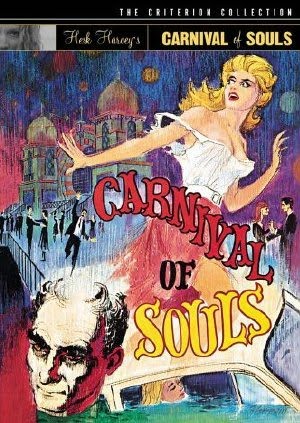
"Carnival of Souls" (1962)

 
  • Director: Herk Harvey
  • Written by: Herk Harvey & John Clifford
  • Starring: Candance Hilligoss, Frances Feist, Sidney Berger & Art Ellison
     There was a huge boom in independent horror in the 60s. The most well-known of these indie excursions is, of course, George Romero's "Night of the Living Dead" from 1968, which launched an entire subgenre of horror films. However, there are other horror films, not as well-regarded and certainly not as well-known, but definitely deserve to be mentioned and talked about. The film that I'm speaking of today is "Carnival of Souls", an intriguing, strange horror film from 1962.
     "Carnival of Souls" begins in a fairly normal fashion, with some guys challenging some gals to a car race. The girls oblige, but racing on a narrow bridge is a bad decision, and the girls' car crashes over the edge, careening into the river below. Just as the police think that they'll never find the car or any of the survivors, Mary Henry (Candance Hilligoss), the lone survivor of the crash, climbs out of the river. Her friends all dead and heartbroken from the guilt of being the only survivor, she becomes a drifter, buying an apartment in town and generally being very reclusive. The only times she goes out are to go to church to play the organ.
     However, soon she is plagued by demonic hallucinations, feverish visions of a man with dark eyes coming after her. Over time, the hallucinations become more and more frequent, and Mary's frequent attempts to reach out to people are in vain. Soon she finds herself drawn, as if in a trance, to an old run-down pavilion, nearby the scene of the crash...
     During the first few minutes of the film I found myself unimpressed by the incredibly low production values and the atrocious acting, but as the film dug deeper and the story grew more and more outrageous and complex I found myself compelled by it's atmosphere. It starts off with time moving in a relatively ordinary way, but as Mary's hallucinations become more intense, the film in turn becomes more and more surreal, and time begins to dilate. Toward the end, we aren't sure of what reality is, and if we can trust all that we're seeing.
     Dialogue becomes incredibly sparse, and Mary begins to (what we are assumed to believe) shift in and out of existence, experiencing strange, dreamlike periods where nobody can see her and she cannot hear them. There's a particularly great sequence where she spends almost 5-10 minutes simply wandering around the town in a daze, reaching out to anybody who will listen to her. But of course, no one can. It's astounding.
     But there is so much more to the film than atmosphere. It's frought with evocative Christological imagery, such as close-ups of stained glass windows adorned with priests, hands held up to the heavens. Music also plays an important role in the film. Mary is a professional organist, and as such the entire organ score becomes darker and darker as the film goes on, carrying us into her psychological despair. Mary's attempts to get closer to people become more and more desperate and saddening, and it endears her to us, despite Hilligloss' hammy acting.
     She and the audience are lead to ask themselves where she belongs, and it is something that Mary struggles with throughout the film. We aren't sure if she is merely suffering from emotional trauma or if she is actually not meant to exist on this plane. One of the things I also find incredibly effective is the fact that we are not told what exactly the beings that she keeps envisioning are. Whether they are mere stress-triggered hallucinations or something more, something not of this world, is left up to the viewer.
     The demons, or hallucinations, or whatever they may be also offer some incredibly chilling moments, especially during sequences where Mary keeps seeing the same ghoul with blackened eyelids, simply staring at her. Every time he is on screen he evokes chills, and it only gets better toward the end when Mary travels back to the pavilion and witnesses a horrifying, hypnotical dance of the dead between many different ghouls.
     In the end, the movie closes on an incredibly bleak and uncertain note, and I'm not entirely sure what the director, Herk Harvey, was attempting to say. Perhaps he was asking us to question our own mortality, or maybe he was offering us an experience in surreality, to show us what it may be like to be a wandering soul, lost in a sea of the living. Are the demons that pursue Mary truly evil for wanting to take her to eternal rest? Perhaps not.
     When any supposedly "low grade" horror movie can force us to confront things like this, and can suck us in so thoroughly with nothing but a spellbinding atmosphere, I think it deserves points. If you ever get the chance to see this film, please try to look past it's technological shortcomings, hokey acting, and somewhat clunky dialogue and instead look into the deeper, more meaningful heart of the film. At only 76 minutes, it's quick, and it sure is worth the ride. Just be careful... the bridge is out.

Aug 17, 2010

"Green Lantern: First Flight" (2009)


  • Directed by: Lauren Montgomery
  • Written by: Alan Burnett
  • Starring: Christopher Meloni, Victor Garber, Michael Madsen  
     Being a kind of scrawny, ropy geeky kid, I love superhero stories. Modern mythology, complex works worthy of critical examination or simple pulpy nonsense, whatever you think of them as, they're certainly an inimitable part of American pop culture. Since I like superhero stories, it follows that I also really admire the catalogue of the DC Animated Universe. When I was a kid I used to watch "Batman: The Animated Series" every Saturday morning, and when I watched the show again as I got older I grew to appreciate it on a deeper level. If it wasn't for the standard that was set by Bruce Timm's creation, it's not outlandish to say that television animation would not have become as sophisticated as it so quickly did back in the 90s.
    While we no longer have any of the DCAU series on our television screens anymore, we DO have the availability of the DCU Animated Original Movies series, which are direct-to-video animated films that tell various stories culled from the DC Comics library. "Green Lantern: First Flight" is the third-and-a-half film I've seen from this line (I saw "Justice League: The New Frontier", "Batman: Gotham Knight" and the last half of "Under the Red Hood", but not the full film), and I have to say that if this is the standard that the Original Movies line has set then I'm plenty happy with it.
    "Green Lantern: First Flight" tells the story of Hal Jordan's (Christopher Meloni) first mission as a Green Lantern. After receiving the Lantern ring from dying alien Abin Sur (Richard McGonagle), Jordan is swept up by the Guardians, the orchestrators of the Green Lantern Corps., and is set to begin training under fellow Lantern Sinestro (Victor Garber). Sinestro and Jordan set out to find Abin Sur's killer, and uncover a scheme involving double-crossing, murder, and betrayal.
    While the film tells a good story, the main problem with it is that it is simply too short. This is certainly not the fault of writer Alan Burnett, who wrote many great episodes of "Batman: TAS". Since pretty much all of the DC Animated Movies have to stay under 80 minutes (I assume for budgetary reasons), the writer's are often forced to speed things up in order to get to the point. Unfortunately, "First Flight" suffers as a result.
    Jordan's origin story is finished within the opening credits, it goes by way too fast. I don't necessarily have a problem with that, after all, they covered his origin fairly thoroughly in "The New Frontier". What bothered me was the way it was portrayed. Jordan doesn't question the situation at all, here is this dying, bright red alien in front of him in a weird suit, offering him a ring. Jordan simply says "All right", and puts it on. I would have made Jordan more inquisitive, and I would have made Sur's death more meaningful. For example, instead of just saying, "All right," Jordan could have said, "Who are you?" or "What...?" and Sur could have cut in with, "Please, you will understand, I don't have much time," or something along those lines. That way the origin could have more impact and we could have sped through to the opening credits on time.
    It also doesn't help that once the credits are over, we're put smack dab into the middle of Jordan flying through the night sky, fully clad in his Green Lantern getup and seeming fairly comfortable with it. It doesn't flow well from the opening credits. It leaves us to assume that he's just suddenly gotten used to his powers, and while we can guess that he experimented with the ring a few times and grew comfortable with his newfound status, the fact that we don't at least see it makes it seem a little unconvincing and rushed. I would think that someone who didn't know Lantern's origin story would be taken off-guard. The least they could have done was put a "Several weeks later..." title on the bottom of the screen. Or, better yet, we could have seen a montage of Jordan learning to use the ring over the opening credits. Just something to better prepare us for the story.
    One other thing that suffers due to the short run-time is the characters. They get almost no development, which I understand since this film focuses on Jordan, but since his fellow Lantern's play a pretty important role in the film it would have been nice to get a little more on them. A prime example of this is the fact that all of the other Lantern's immediately hate Jordan for seemingly no reason. We are told that they have a distrust for humans and that they were all close to Abin Sur and resent him taking his place, but that seems like shaky motivation, and since we aren't given sufficient reason as to what made Sur so great, it's not very believable. But as I said, this is due to the short run time and is probably not the fault of the writer.
    The best thing about the film is the first half of the story, as we see Sinestro and Jordan search for Abin Sur's killer. It takes the form of a pseudo-mystery story as they scour nightclubs and interrogate criminals. It's exotic and interesting, we get to see lots of different kinds of aliens, and it reinforces the idea that the Green Lantern Corps. are basically Space Police, which is a fun concept that I wish we could have seen more of.
    The second half of the story, about Sinestro's betrayal of the Guardians, is less interesting because as soon as we get to this point it quickly devolves into a by-the-numbers superhero film, with Sinestro playing a fairly generic villain and having a generic climactic fight scene with Green Lantern (this climax, by the way, uses a really, really cheap deus ex machina that almost killed the film for me). This is disappointing, because Sinestro clearly has potential for development, the problem with this is that, as I said, the filmmakers obviously wanted to quickly get to the meat of the story, and consequently Sinestro just becomes a fairly uninteresting, mustache-twirling baddie.
    However, the film certainly isn't bad, and it's pace doesn't completely destroy the film. In fact, since the film moves so quickly, it's fairly entertaining and exciting. The film is at it's best when it plays the part of a high-flying science-fiction story, where we get to catch a look at all of the various aliens that populate the Green Lantern universe (and the Corps. itself). The voice acting is also pretty good, Christopher Meloni stands out as a very snarky Green Lantern, and Victor Garber is incredibly intense and slightly creepy as Sinestro. Michael Madsen also isn't bad as Kilowog, the giant, pig-like alien of the Green Lantern Corps.
    One of the other things that surprised me about the film was it's tone. It's pretty dark and violent for a PG-13 animated movie. Not only do we see some aliens doing drugs in a bar, we also meet an alien prostitute, and on top of that a few characters get killed in pretty violent ways. One in particular actually gets gored by a bed of spikes, and when the character dies they slide off with some nice squelchy sound effects. Two other characters get their necks snapped, and another gets his hand broken after Kilowog steps on it. There's also some curse words tossed around.
    I'm really happy that they're going this route with the Animated Films, because now that they're not tethered by being on children's television they have a lot more creative freedom, and this film shows that they're using that to their advantage. Besides, any animation that is willing to push the envelope gets kudos from me. Too often animation is considered a kid's medium, so it's encouraging to see that some filmmakers are willing to work past that stigma.
    The animation is also above-average for a direct-to-video film. However, there is some god-awful CGI in parts, and at times the characters move a little bit choppily. The general style is also a bit too "anime" and angular, but otherwise it's nice. In particular the animation is very elaborate and well-rendered during the fight scenes, which are exciting and well-choreographed.
    Overall, "First Flight" is a well-rendered, fun superhero film that unfortunately suffers from a short run time and a by-the-numbers plot. If you like superhero films then I'd pick it up, but if not then this film isn't really going to make you look at the genre any differently.

Aug 14, 2010

"The Expendables" (2010)

 
  • Director: Sylvester Stallone
  • Written by: Dave Callaham & Sylvester Stallone
  • Starring: Almost Every Action Hero Ever
    Wow, "The Expendables"! A modern action film starring a whole bunch of big name action stars! I couldn't wait to see this film, the concept sounded badass. I mean, Stallone and Dolph Lundgren, together again? Jet Li? Bruce Willis? ARNOLD SCHWARZENEGGER? If this movie didn't seem interesting to you, you must have been a preening nancy boy! How could they go wrong?
    Oh... they go wrong. They go very, very wrong. They go wrong on so many levels that it should be a fucking sin, and Stallone and the screenwriters should be cast into the most horrible, depraved pit of Hell for unleashing this cinematic travesty upon the world. My god...
    The plot... shit, was there a plot? I have no idea. It has something to do with some made up island in Venezuela or something, and Stallone and his team of bulky action heroes are supposed to go in and kill some guy that was a former CIA agent, and there's also some stuff about the leader of the island and his hot daughter... I don't know, who gives a shit? The film is so fucking convoluted and confusing with all kinds of intersecting plotlines and boring "political intrigue" that I almost went into a coma. Characters disappear and then reappear, they do things that don't make any sense, and there are so many ancillary characters that I have no idea who is who or how they completely fit into the plot.
    But who cares about the plot, really? It's an action film, right? And it has almost every major star ever! Well, you're wrong my friend. Yes, every name that is on the poster make an appearance in the film. However, the core "Expendables" group is made up of Sylvester Stallone, Jason Statham, Jet Li, Randy Couture, and Terry Crews. Everyone else, like Steve Austin, Dolph Lundgren, and Mickey Rourke, are either enemies or simple cameos.
    Still, that would be fine, but you know who the film decides to focus on? Statham and Stallone. That's it. They get the most screentime, the most backstory, the most action scenes, they get almost the entire film. The rest of the Expendables, you know, THE GROUP THAT THE FILM IS NAMED AFTER, get 20 minutes or less of screentime, and when they are on screen, all they get is the occasional one-liner to vomit out during a firefight. The film is basically Stallone sucking his own cock.
    Dolph Lundgren by far gets it the worst. The amazingly cool action star who was fucking Ivan Drago in "Rocky IV" becomes a villain, betraying Stallone. On top of that, he gets killed after Stallone shoots him! All in all, he has about 30 minutes of screen time, granted, a bit more than the rest of the group, but still! I'd say becoming evil and getting fucking killed is much worse than simply being one of the background characters (besides, who cares about no-names like Randy Couture?).
    Stallone obviously has some sort of personal vendetta out for Lundgren. He defeated him in "Rocky IV", what more does he want? Defeating him AGAIN at this point, 30 years later is just a kick in the balls for Lundgren, who by all accounts is a nice and charismatic guy.
    I'm sure you were also excited about Bruce Willis and Arnold Schwarzenegger, right? Well you can fuck off for all the movie cares! Willis and Schwarzenegger literally get 5 minutes of screentime. I can deal with that, Schwarzenegger is still governor and is probably very busy and Willis probably had other projects going on at the time. But you know what they do during this 5-minute cameo? They fucking talk. Two of the most badass, quintissential action stars get a cameo in one of the biggest action films of the year and they fucking talk. Seeing the trio of Stallone, Schwarzenegger, and Willis together is also incredibly surreal. All of these big action stars just standing there, talking like they're old chums. It feels less like they're playing characters and more like they're playing themselves, especially when Stallone takes a jab at Schwarzenegger by saying, "He wants to be president."
    That's one of the major problems with the film as well. It has a hell of a lot of star power with some of the biggest action heroes ever, but it's not executed very well. As I said, the screen time for each star is incredibly discordant, but they're also each shooting out one-liners, as they would if they were in their own solo films. But this just comes off as incredibly strange, like an action hero "Celebrity Deathmatch", if you will, with all of these big names fighting for supremacy, battling for the most amount of one-liners until they accidentally break the fucking universe from one-liner overload.
    Again, this would be fine if the dialogue had any sort of competency, even to the point of being so lame it's awesome. But no, it doesn't even have that. It's beyond bad-good, it's so far beyond bad-good that it's created it's own separate universe created especially for itself. I will share some of the lovely exchanges in this film:
    There's a scene right after Statham has just shot up a bunch of bad guys with a gun. Stallone turns to him and says, "That was some good shooting." Statham responds with, "That was a statement!" I'm not fucking with you guys. That is real, actual dialogue from the film. It's not even a one-liner, it's Statham explaining what Stallone just did. He might as well have just said, "THAT WAS A SENTENCE."
    There are also some bits of dialogue that just don't make any sense, like they were trying to make a one-liner but gave up halfway through, pulled a shot of tequila and said, "FUCK IT". For example, there's a scene where Terry Crews is showing off his weaponry to Randy Couture. He says something about how if his gun can't do the job, then his knife can. Couture responds with, "You should be my doctor." What?! What does that even mean?! It's like they were talking to two completely different characters on two completely different dimensional planes and the camera somehow caught the two dimensions in transit.
    The film is full of completely retarded things like this. Even the character names sound like something a 12 year-old with Down's Syndrome would come up with. Do you like a bunch of badass, grizzled action heroes that could rip your face off? Well then get ready for such awe-inspiring names as "Hale Caesar", "Lee Christmas", and "Yin Yang". Again, those are actual character names, they are completely real. They named a fucking Asian character "Yin Yang". Words fail me.
    "But wait," I can hear you saying in my head, "surely the film has a lot of great action scenes, right? I mean, with all of that action hero star power there must be some great stuff, right?" Okay, you want to know what the action is like? You really want to know? Well, I hope you like ShakyCam! LOTS AND LOTS AND LOTS OF FUCKING SHAKYCAM. IN ALMOST EVERY SINGLE SCENE.
    The cinematography is some of the worst I've ever seen in a film. It's like they hired a spastic retard to control the camera at the exact same time there was a planet-splitting earthquake. I get that they were trying to go for a gritty, docudrama style, but why the hell does the film need it? Especially a film with a bunch of complex action scenes where it's integral that we know what the fuck is going on?! Half the time I couldn't tell what I was looking at or who was fighting who, and it didn't help that the color scheme in the film consisted of black, grey, and puke green. It literally looked like somebody vomited on the lens.
    Overall, "The Expendables" is a great example of wasted potential. It's one of the coolest-sounding action movies ever, I thought that there was no possible way they could ever fuck this up. Well, they did. The film has so much wasted potential you could compress it into a small star. The fact that they could screw something up with this much potential has pretty much completely destroyed my faith in Hollywood. Granted, it was slim before, what with "Avatar" making 2 billion dollars and whatnot, but this is just the lowest of the low. Hollywood has become like the crazy drug addict that is sucking dick for money. It has no shame and is willing to do anything at all to get some money. Fuck this bullshit. Fuck it to hell.

Aug 9, 2010

"Conan the Barbarian" (1982)

This movie poster, by the way, is illustrated by Frank Frazetta, a noted fantasy artist who illustrated many of the Conan stories. It kicks so much ass I don't even believe it.
  • Director: John Milius
  • Screenwriters: John Milius & Oliver Stone (wow!)
  • Starring: Arnold Schwarzenegger, James Earl Jones, Sandahl Bergman, Ben Davidson, Mako
     I go crazy for old pulp-style adventure and fantasy films. The "Flash Gordon" serials, hell, the "Flash Gordon" movie, "Indiana Jones", I love them all. It also goes without saying that one of my favorite writers is Robert E. Howard, who originally wrote the short stories that this film, "Conan the Barbarian", was consequently based on. The stories are brilliant. Gritty, dark, pulpy, and adventurous, with a slick, poetic prose style.
     I love the mythical "Hyborian Age" that the Conan stories take place in as well, full of shape changing demons, grizzled barbarians and intense violence. It's a world unlike any other. Naturally, with the author having such a high pedigree, I had high expectations for the "Conan the Barbarian" film. I had heard much about it but never really had the chance to watch it until, on a whim, I purchased it from Dimple Records and watched it one night with friends.
     Concerning the plot, it "borrows" scenes and elements from Howard's stories without adapting any one story, so a lot of the character's backstories are changed. Conan (Arnold Schwarzenegger) is a young Cimmerian boy who is stolen away and made into a slave after his family's tribe is murdered and ransacked. Many years later, he escapes and meets several friends who help guide him to his family's killer, the mad Snake Man cultist named Thulsa Doom (James Earl Jones). Can Conan vanquish the man who stole his life and bring peace to his existence?
     Yes, he can, with lots and lots of bloody murder. I had forgotten that this film was rated "R", and for an early-80s', non-slasher film, holy hell, it lives up to that pedigree. Conan practically kills the entire country, and there is lots of big, bright, wet bloodspray, it's beautiful. I was really happy to find out that they carried over this hard, gritty tone from the stories, sparing no violence or sex. It may not contribute much to the plot, but it does wonders for the overall tone.
     Plus, the fight scenes are incredibly well-choreographed. Conan leaps off of walls and performs elaborate sword spins, just mowing down everyone in sight. The gore effects are also incredibly good for the time, my favorite sequence being when Conan decapitates a giant snake. It doesn't do any pussy cutting away, and it actually takes Conan several hits to decapitate it. It's incredibly ballsy, especially since we're talking about animal killing here, which is generally frowned upon in films.
     While the plot itself is paper-thin, there's just something about the atmosphere and the high production values of the whole film that draws me in. The film employs many huge, ornate set pieces, and there is little dialogue in the film. Often it simply involves Conan traveling somewhere, fighting someone, or taking in the landscape, and it's very hypnotic. Of particular note is a fantastic scene where Conan's lover, Valeria, tries to ward off demons from his supposedly dead body.
     The film's atmosphere is also gritty, but not like the "Clash of the Titans" reboot, where it disengages us from the fantasy in favor of the grittiness. In this instance the grittiness actually enhances the film, because the fantastic elements are nicely balanced with the grittiness, and it's all very believably presented, especially considering the source material.
     However, one of the things that bothers me about the film is it's aforementioned plot. While it borrows the general feel and scenes of some of Robert E. Howard's stories, none of it is particularly compelling. Which is incredibly disappointing, because Howard could spin some damn fine tales, full of intense prose and deep, intriguing characters.
     Because the plot of the film is so paper thin, the characters don't have much to them, and Arnold Schwarzenegger's "performance" (if you want to call it that) simply makes Conan look like a brutish, unintelligent ape, which is a far cry from the literary Conan, and it doesn't make the character particularly intriguing, which is sad because he's the centerpiece of the film.
     The rest of the actors do fine. They're not particularly good, but they deliver their lines in that early-80s, articulate fantasy vibe, which I find endearing in a cheesy sort of way. There are some noted actors in it though, like Mako in all his hammy glory as The Wizard, and Max von Sydow, who has a very brief cameo as King Osric.
     James Earl Jones though... man, he steals every scene that he's in. He doesn't even say much, really, but he doesn't need to. He has incredibly piercing, steely blue eyes (which I think are effects, but if not, holy shit) that draw you into his gaze, almost hypnotizing you to do his will. He's so icy and cold, nonchalantly slicing people's heads off. He also has a great monologue toward the end about fearing the dark. Oh, and he turns into a giant snake for some reason. But who cares, it's FUCKING COOL.    
     Supplementing the beautiful visuals and dark, fantastic atmosphere is the brilliant score by Basil Poledouris. Reportedly Dino DeLaurentiis (the producer) wanted a pop score, but director John Milius advised against it, and I'm damn glad that he did. The score is bombastic and sweeping, with a particularly fantastic cue inspired by Prokofiev's "The Battle on the Ice" from his score for "Alexander Nevsky". It plays a huge part in establishing the atmosphere of the film, giving it life.
     There really isn't much reason to see this film if you're one of those "normal" people. But if you're a kind of geeky fantasy nerd like myself, you'll probably be plenty surprised by "Conan". While there isn't much of a plot, I can't help but feel that there is something about the movie that draws it above a simple B-grade fantasy film. It's got great production values, for one thing. It's beautifully shot and scored. It's gritty, violent and sexual. It has some fantastic atmosphere and some great acting from James Earl Jones... I can't explain why, but I love it, even though it doesn't stick to the canon of the short stories. If you're into this kind of stuff, check it out.

Jul 25, 2010

"Inception" (2010)


  • Written & Directed by: Christopher Nolan
  • Starring: Leonardo DiCaprio, Joseph Gordon-Levitt, Ellen Page
     So, Christopher Nolan's epic follow-up to "The Dark Knight" is finally here. Everyone has been speculating as to what he would come up with, and have been waiting with bated breath (well, besides me, probably... I never paid attention to the ads). It turns out that what he came up with is the film "Inception", his first original film in about 10 years.
     "Inception" is essentially a heist film with a science fiction twist: Dominic Cobb (Leonardo DiCaprio) is a conflicted fugitive who has found a way to make money through a process called "extraction", in which they break into a person's dream-consciousness in order to steal an idea or some important information. This all goes well until Dom is given a proposal to plant an idea, instead of simply stealing it, known as "inception". What follows is his attempts to gather a team of inception experts as well as confront his own subconscious demons.
     Now, before I get into the actual review itself, I should probably clarify that I liked the movie before a whole bunch of Chris Nolan fan-tards bitch at me. I enjoyed it. It was fun, well-made and suspenseful. HOWEVER, I do have some reservations with it. For a long time I couldn't figure out what bothered me so much about the movie. I enjoyed it, but just something about it wasn't blowing me away and I couldn't figure out what. But after thinking about it for a while, I've finally figured it out, and I have several problems with the film itself.
     Firstly, the main thing that really bothered me about the film was that it never got very visually crazy. There were a few (admittedly amazing) setpieces such as the rotating hallway and the world of "limbo", but overall the film felt very normal and very confined.
     In other dream-related movies such as "The Cell" and "Dreamscape", the dream world is much more vivid and strange and reflects the look of dreams much more faithfully. Half the time I kept forgetting that I was watching a movie about the invasion of dreams and felt more like I was watching a regular old heist movie.
     Perhaps budget constraints kept the film from becoming very surreal, but I find it much more likely that Chris Nolan was his usual cripplingly realistic self and purposefully kept the film to a very surrealistic minimum. Because, you know, FUCKING DREAMS are well known for being incredibly believable and realistic.
     Secondly, the films supposed intelligent, philosophical undertones are not nearly as radical and mind-blowing as everyone would like to believe. The idea that the world around you isn't real and that you must question your reality 24/7 is basic philosophy, hell, ever since The Matrix this idea has become commonplace, pedestrian even. But the movie has a kind of smug, serious attitude to it, as if Chris Nolan believes that his themes are deep and complex and totally original.
     I don't mind the theme of exploring your own reality, hell, I expect it in a film like this, but like the visual style, this theme feels really subdued, they touch on it but they never really explore it, and Nolan's screenplay is so overwrought and takes itself so seriously that it's almost as if he expects us to bow down to him immediately. The film also isn't as confusing as everyone thinks it is. Sure, it's a long-ass movie, with multiple plot threads and ideas running through it, but if you really pay attention you should have no problem what's going on.
     Thirdly, while the concept is great and the heist itself is exciting, there isn't a whole lot of emotional weight to any of the characters. Apart from Cobb's character, who is the centerpiece of the film, none of the other characters have any development whatsoever, they're only there to get Cobb where he needs to be or to serve as a cheap way for the filmmakers to rack up suspense (e.g. Saito). Apart from that, they're just window decoration, basic heist film archetypes.
     Another thing that bothered me about the plot itself is the fact that a lot of the film's logic seems like an incredibly amateurish way to amp up the suspense. I've already mentioned Saito, but the whole aspect of "limbo" bothers me. The idea that you can stay in a dream for years and go crazy sounds interesting on paper, but in execution it doesn't really make a lot of sense. Generally when people have dreams for 10 hours it doesn't involve them living out a whole other life and then going insane. Neither do people go insane when they DO have dreams where "years" pass (and yes I have had dreams like this before).
     I get what they're trying to do, but Nolan really could have come up with a better way to "raise the stakes", so to speak. Since almost the entire film takes place in a dream, there's not really any reason for us to worry about what's going to happen to the characters. If they die they go in limbo, sure, but really I'm not convinced of the whole logic of limbo, and beyond that there isn't much else at stake here, besides Cobb not seeing his children (which I didn't end up giving a flying fuck about in the long run).
     Now, those are my biggest problems with the film. But now I've realized that I've made it sound like the film is a piece of shit and I hated it, which is far from the case. I actually really enjoyed the film. It's very well shot, has a great musical score, it's well-acted (I particularly liked Ellen Page and Joseph Gordon-Levitt) and is (mostly) thrilling and suspenseful.
     Cobb's backstory is rendered well, although whenver it comes into play it tends to slow down the action, but I can forgive it. There is also a liberal use of practical special effects, which I am always an ardent admirer of, and this leads to some amazing scenes. The aforementioned zero gravity hallway fight had my jaw on the floor. Sure, it felt very "Matrix-y", but it was executed extremely well and I couldn't believe they actually built and maneuvered that hallway in real time.
     When it all comes down to it, this film really feels like nothing more than a great idea with some good bits that wasn't really carried through as much as it should have been - honestly, I have to say that I was only so immediately invested in the film because I loved it's concept so much. However, I'm glad that films like this are being given a chance in Hollywood. It shows the money-grubbing fatcats that high-concept, high budgeted action films can survive, and that (mostly intellectually dead) summer films can have a brain as well as muscle - but it's simply just not the amazing work of art that everyone so desperately wants it to be, and Nolan is NO Kubrick.